How Tide It picks your GO windows
A GO window is a run of hours where everything suits you. Here is exactly how the app works it out: the criteria, their weights, the thresholds, and what it refuses to do.
1. A score for every hour
For every hour of the week, the app gives your sport on your spot a score from 0 to 100. It crosses several criteria, each with its weight:
| Criterion | What matters | Weight |
|---|---|---|
| Wind | within your range, ideally in the middle | 32 % |
| Water depth | enough water to ride (26% for foil, which needs more) | 22 % |
| Direction | offshore wind drags the score down | 16 % |
| Waves | a rough sea counts against, except in a sheltered bay | 12 % |
| Gusts | the gap between gusts and the average wind | 10 % |
| Tide coefficient | very big tides add current | 6 % |
| Temperature | of the water, or the air if missing | 5 % |
Missing data is worth neither zero nor a hundred: the criterion drops out and the score is computed on the others. Without a wind forecast, though, no hour is offered.
2. A threshold that depends on your level
An hour becomes GO when its score clears your level's threshold. A beginner only wants clear-cut slots: the bar is high. An expert accepts marginal ones: the bar is lower, so more windows. Your level also sets a wind ceiling and a wave ceiling.
| Level | GO threshold | Max wind | Max waves, kite | Max waves, foil |
|---|---|---|---|---|
| Beginner | 68 | 35 km/h | 1.0 m | 0.8 m |
| Intermediate | 60 | 50 km/h | 1.5 m | 1.2 m |
| Advanced | 52 | 62 km/h | 2.5 m | 2.0 m |
| Expert | 46 | 90 km/h | 3.5 m | 3.0 m |
The max wind never goes above the one you set yourself: the lower of the two applies.
3. The rules that rule an hour out, whatever the score
Some conditions can't be traded off. A good score doesn't make up for a dangerous hour:
- night time, from sunset to sunrise;
- wind below your range, or above your level's ceiling;
- gusts more than 10 km/h above your ceiling — 10 km/h is the usual error of a forecast on gusts: any tighter and the app would cry wolf half the time;
- waves higher than your level's ceiling, for kite and foil;
- not enough water: the score is then capped near the bottom;
- outside the spot's tide window, on spots that only work at certain tides (for example "from 3 h before to 3 h after high tide").
4. From hours to windows
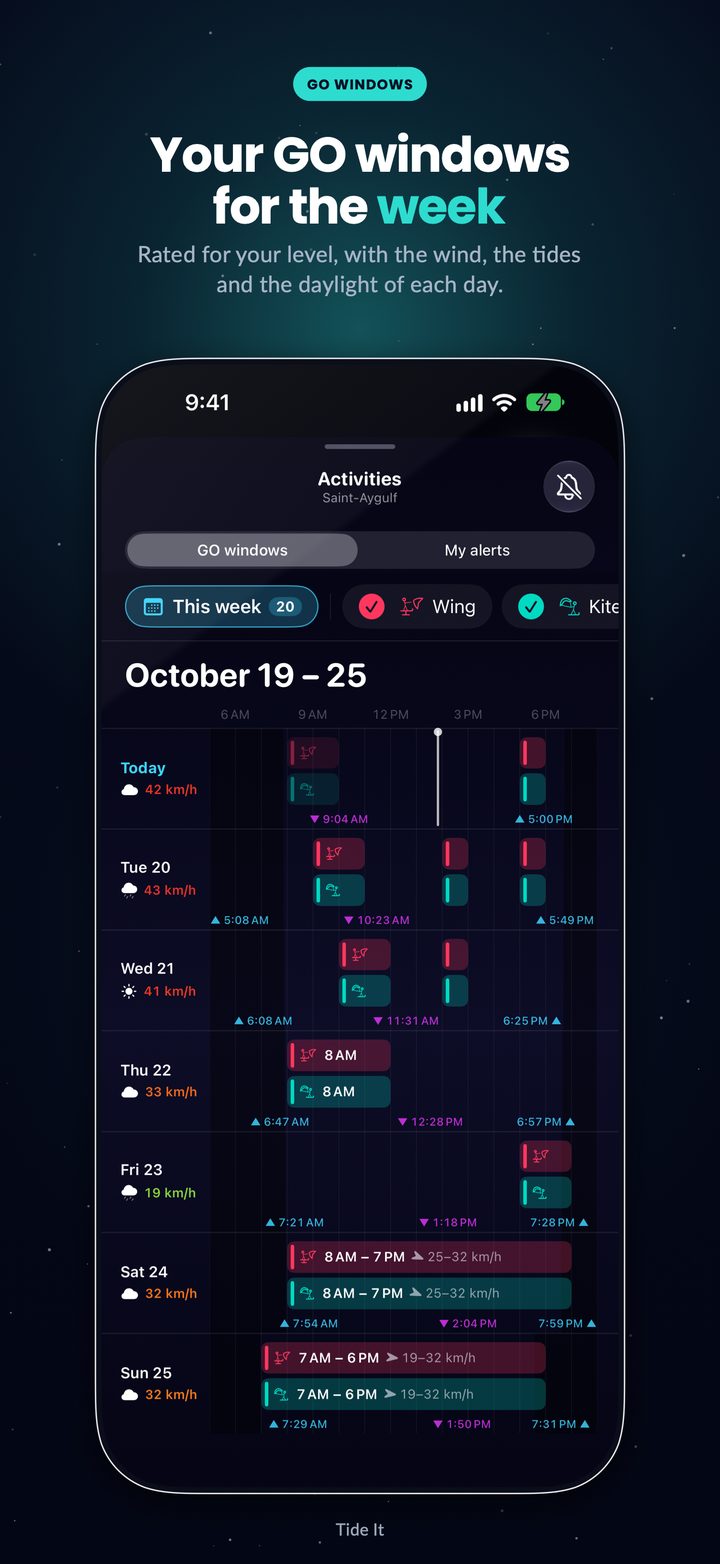
Consecutive GO hours make a window. A gap of an hour or less between two windows is bridged, so a session isn't cut for one borderline hour; a window lasts at least an hour. A day with no window isn't left silent: the app shows the day's strongest wind, so you know why.
5. One forecast, and the station to confirm
The score relies on a single forecast model, the finest available on your spot — down to 1.3 km along the French coast. Speed, gusts and direction come from the same model: mixing them would give a heading no model predicted. We measured it on about 2,800 hours of real wind along the coast: the best model alone beats an average of several.
The nearest station never changes the forecast. It confirms the present moment: for the next two hours only, and with a reading less than 20 minutes old. Beyond that, a station says nothing about tomorrow.
6. What the engine doesn't know
It doesn't know the shelter a dune gives on a cross-shore day, the current in an inlet, your gear or how you feel today. GO windows are a decision aid built on forecasts: at the beach, your own eyes, the station and the riders already out have the last word.
Rather decide yourself? In manual mode you write your own conditions (min and max wind, direction, tide…) and an hour is GO when they're all true. Surfing has its own calculation, based on the swell.
The 7-day GO calendar is part of Premium, with 15 days free when you install. Figures from version 6.2.8 of the app.
Beginners: how to pick the right day →