Beginner kitesurfing: how to pick the right day
When you're starting out, the hardest part isn't the bar, it's knowing when to go. Five questions to ask before you load the car, and how to let your phone answer them.
1. Is the wind in your range?
Every rider has a wind range: enough to get going, not so much that you lose control. It depends on your weight, your kite size and your board — your instructor will tell you yours. Many schools start beginners at around 12 to 20 knots, but it's YOUR range that matters, not your neighbour's.
Too light and you spend the session relaunching the kite. Too strong and you get yanked: that's the most dangerous case, and the most common one with beginners who “give it a go anyway”.
2. Are the gusts reasonable?
The average wind doesn't tell the whole story. If the gusts go much higher than the average, the wind is irregular: your kite pulls hard without warning. A steady wind, even a bit lighter, is better for learning than a strong, choppy one.
3. Where is the wind coming from?
Wind blowing in from the sea (onshore) or along the beach (side-shore) brings you back to the shore. Wind blowing from the land (offshore) takes you out to sea: it's a trap, especially when you're learning. It's also gustier, because it has crossed dunes, trees and houses.
Simple rule: offshore wind, never ride alone — and don't ride at all while you're a beginner.
4. Is the tide right?
On many spots the tide decides everything. In a bay or an estuary you often need enough water; on a beach, high tide can swallow the area where you pump up your kite. On big tides the water comes in fast and the current gets stronger.
Ask about your spot: at which tide it works, and at which tide it gets tricky.
5. Will you have enough daylight?
A session that starts late ends in the dusk, when the wind often drops and nobody can see you any more. Keep a margin before sunset.
At the beach: look before you rig
The forecast says what it will do; at the beach, check what it's doing. A nearby wind station gives the wind actually measured, and the riders already out tell you a lot: if they're struggling, it's not your day. When in doubt, stay on the beach — there will be other sessions.
And while you're learning, ride supervised: a school, or riders who know you.
GO windows: your best slots of the week
That's why we built Tide It. You pick your sport (kite, wing, kitefoil, windsurf), your level — from beginner to expert — and your wind range. The app then crosses, hour by hour, the forecast wind, the gusts, the tide and the sun, and shows you your GO windows: the slots that suit you.
It leaves out what doesn't fit:
- wind too light or too strong for your range
- gusts too strong
- night time
- the wrong tide, on tide-dependent spots
- and it flags offshore wind
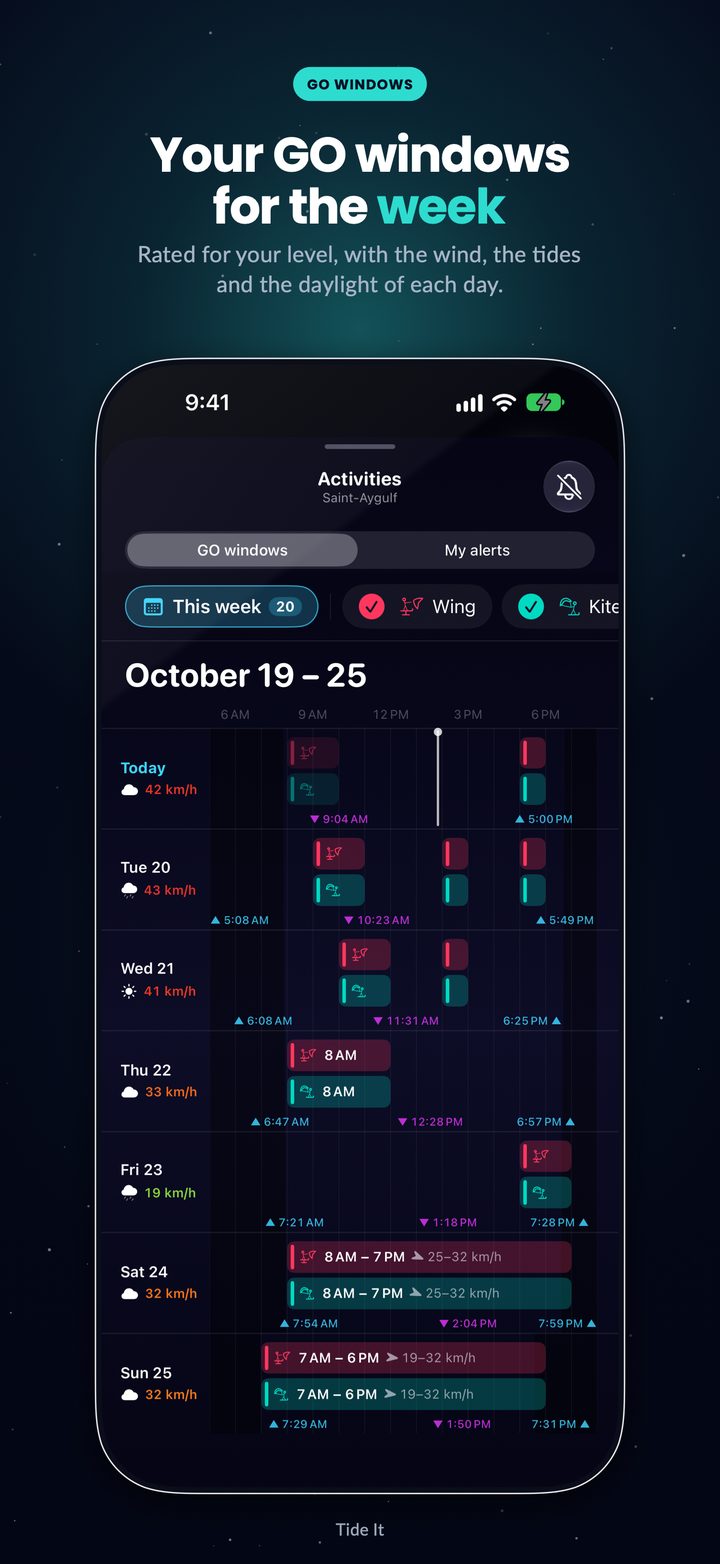
At the beach, the wind measured by the nearest station confirms it before you rig, and “Is it on?” tells you if the riders already out there are having fun.
More than 2,000 kite, wing, windsurf and surf spots are in the app, across France and the world's big kite spots.
The 7-day GO calendar is part of Premium, with 15 days free when you install. GO windows are a decision aid based on forecasts: they don't replace your own eyes at the beach, or a school's advice.
How Tide It picks your GO windows →
The tide coefficient, explained →